What is M-STEP?
M-STEP stands for Michigan Student Test of Educational Progress, the state of Michigan's official standardized test given to students each spring in grades 3-8. If you're as old as we are, you're probably thinking, "I didn't take this test when I was in school." And you'd be correct. Previously, MEAP was the state's assessment system for grades 3-8. M-STEP completely replaced MEAP beginning in 2015.1
Student M-STEP performance is measured as one of four levels: advanced, proficient, partially proficient, and not proficient.2 ELA refers to English Language Arts. For ELA testing, students are measured on more than just reading. The assessment covers four areas: reading, writing, speaking/listening, and language.3
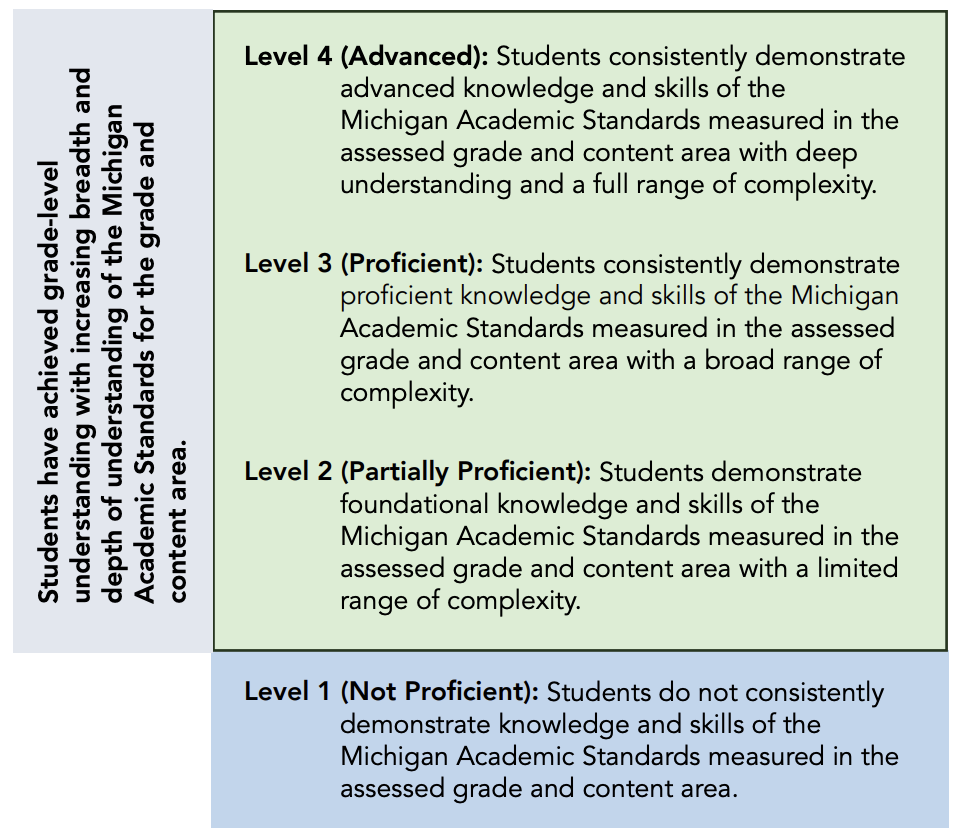
M-STEP assessments are "meant to measure understanding of a broad set of rigorous subject matter standards. Because these assessments are high-bar tests, students who score partially proficient are not necessarily performing below their grade level, and many who are below the proficient benchmark are successful throughout school, in high school, in college, and in their chosen professions." — Michigan Department of Education4
Note that there are online practice tests for M-STEP ELA and all other M-STEP assessments if you are interested in reviewing questions that students are asked at various grade levels.5
Rockford's results
In Rockford, 61.7% of third graders were rated proficient or advanced. 38.3% were rated partially or not proficient.6
It goes without saying, but we will say it anyway: we should absolutely care about every child who needs support with reading. But we've seen these results articulated as simply "38% of Rockford third graders can't read" — and this is not how this assessment should be interpreted.
Context: How does Rockford compare?
Rockford's 61.7% figure is substantially higher than Michigan students overall. Statewide, 38.9% of third graders were rated proficient or advanced.6
And remember: partially or not proficient does not mean "can't read." It indicates that students have demonstrated foundational knowledge and skills across many ELA concepts measured, even if they have not yet demonstrated them across the full range of complexity the test assesses.2
The 85.4% figure, explained
The state of Michigan notes that students rated in the top three categories — advanced, proficient, and partially proficient — in aggregate "have achieved grade-level understanding with increasing breadth and depth of understanding of the Michigan Academic Standards for the grade and content level."2
For Rockford, 85.4% of students fell into one of those three categories. In Michigan statewide, 63.5% of students did.6
Performance trends over time
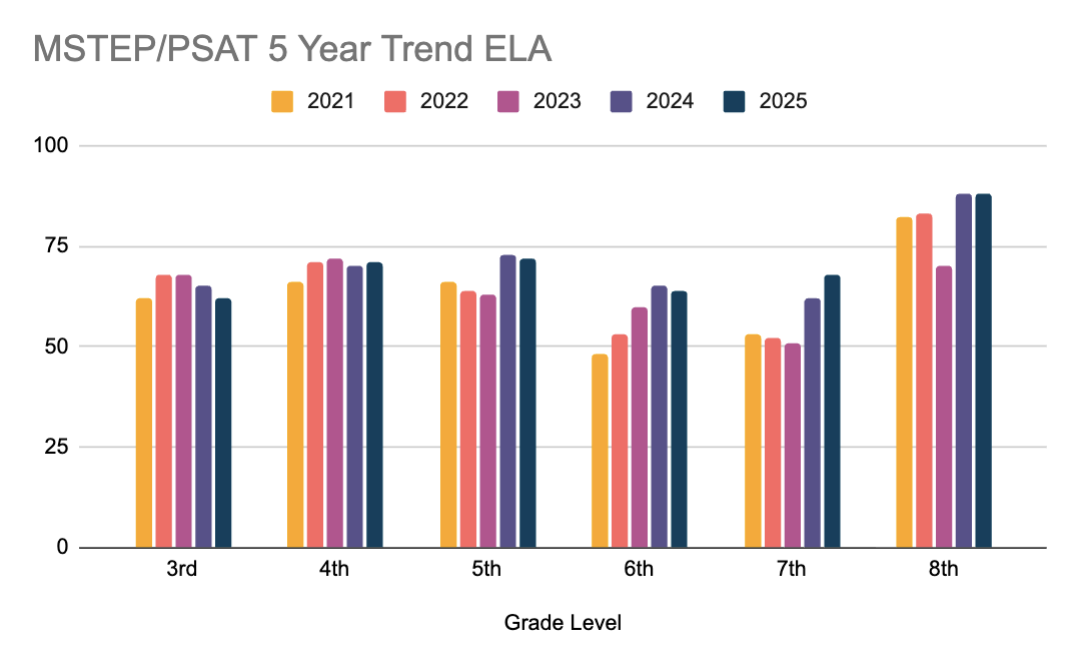
At the December 8, 2025, RPS School Board Meeting, M-STEP/PSAT trend data was shared as a line chart. We felt this format made it difficult to compare performance by grade level for each year, so we reformatted it as a bar chart. The y-axis represents percentile (not written on the original chart, but stated during the live presentation), which shows how Rockford students compare, by grade level, to peers from across the nation.
The data illustrates that Rockford has shown increases in student performance across most grade levels from 2021 to 2025, relative to their national peers.3
NWEA reading results
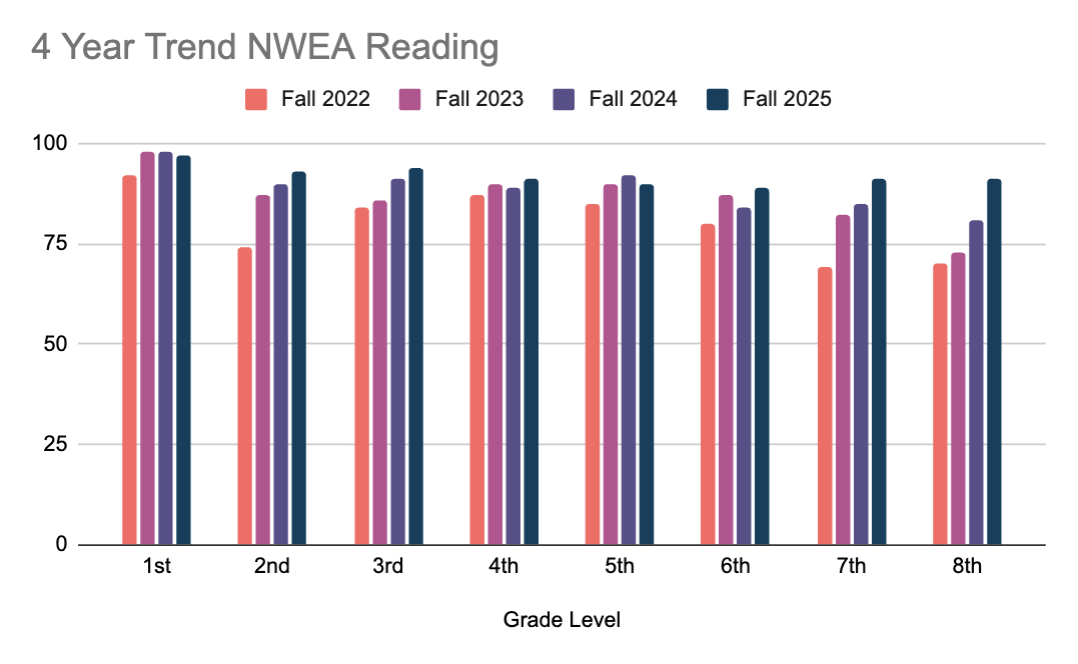
Rockford's strong performance isn't limited to one assessment. The NWEA reading test is also administered each year. NWEA stands for the Northwest Evaluation Association, a nationwide organization that has partnered with thousands of school districts across the country to compare a student's performance to other students in the same grade nationwide.7
RPS's district-wide average NWEA reading results have shown improved performance over time as well. The data below was presented during the same December 8, 2025, School Board meeting. Rockford has seen steady increases in NWEA reading scores from 2022-2025 fall assessments, as compared to their national peers.3
We believe these data points and trends ARE something worth celebrating.
What comes next
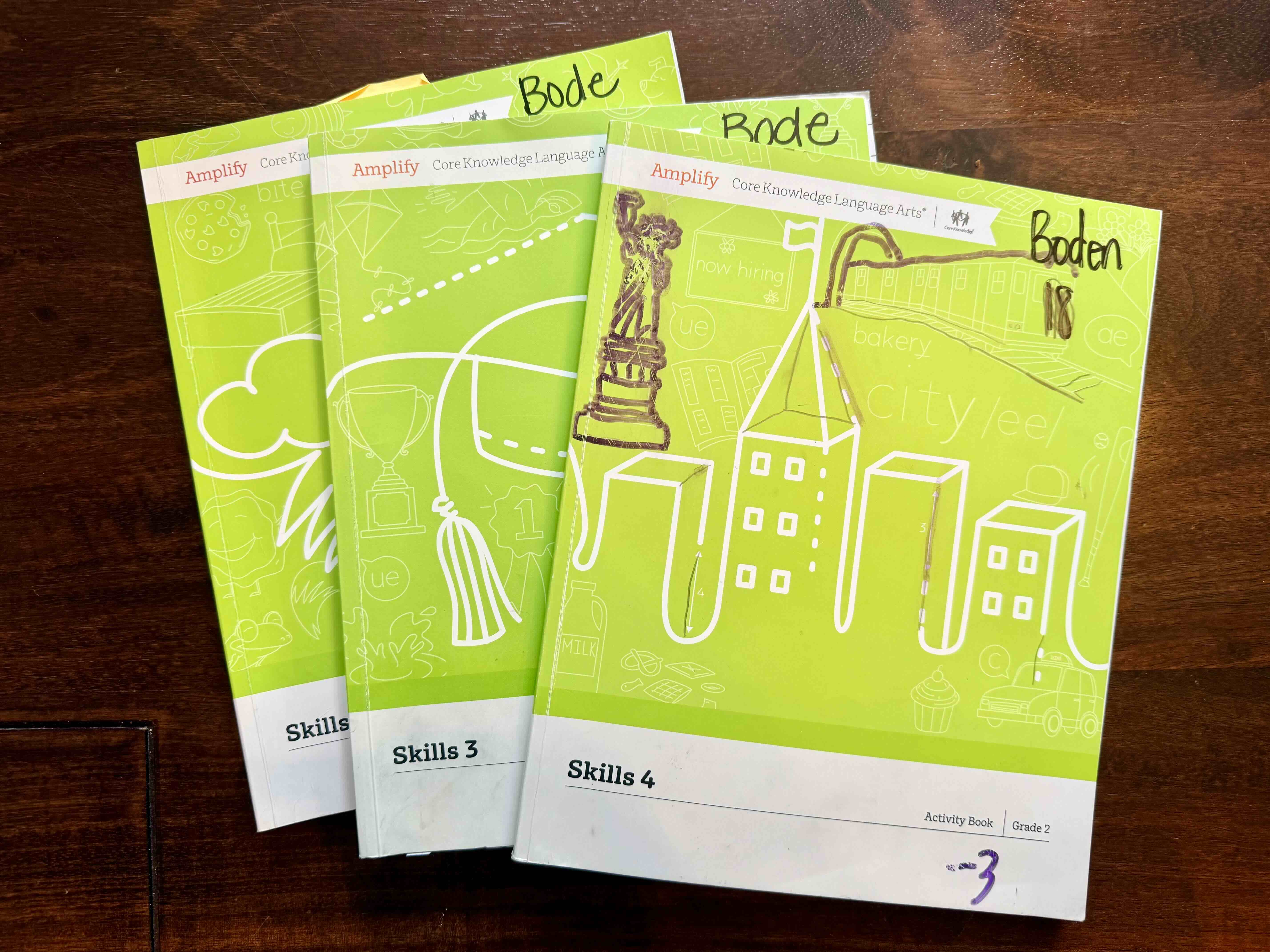
This doesn't mean we stop pushing for improvement. Michigan's overall third-grade ELA scores saw declines since 2020, and Rockford has had its challenges as well.6 In Fall 2024, RPS adopted a new ELA curriculum for elementary classrooms called Core Knowledge Language Arts, or CKLA.8 This curriculum is built on evidence-based Science of Reading research and is used by many districts nationwide.9 Early research shows promise in its ability to impact learning gains and standardized assessment performance,10 and more time is needed to understand its longer-term impact.
Both things can be true
In summary, both of these statements can be true at the same time:
- + Rockford students are achieving at a high level across a broad range of ELA concepts.
- + Evidence-based approaches to help students achieve the highest levels of success in reading and ELA must continue to be identified, implemented, measured, and optimized.
This is the discussion we want to have: one grounded in the full picture, not one based on a single, misconstrued statistic. One that celebrates what's working, while also pushing for continued research and sustained investment in ways that help students achieve more.
Why this context matters to us
We've had third graders. We have third graders coming up behind them. There are hundreds of Rockford third graders in our community. And through years of volunteering, subbing, and simply being part of our schools, we have come to know and love Rockford's third-grade teachers, too.
We've seen firsthand how the oversimplified "38% can't read" statistic lands. Not just in isolation, but also how it lands on the teachers who pour themselves into these kids every day. It is simply not true that more than 1 in 3 of our community's third graders "can't read." That is not what the M-STEP data says, and our students and teachers deserve to have that statistic put back into its proper context.
We'd also be remiss not to highlight a purely human aspect to this. These assessments are a one-time test taken in a few hours' span. Have you ever had a bad day or week, and it impacted your ability to do your best work? A student can perform "poorly" for many reasons outside of their actual ability level. Are they a bad test taker who couldn't sleep the night before from worry? Are they hungry or not feeling well? Did they get in a fight with a friend or take the test in an overheated room? These are all elements that can impact individual performance on test day that shouldn't be discounted.
We also know there is always room to grow. We want every child to become a stronger reader, and we are dedicated to supporting those who make that possible each day.
When you have third graders riding their bikes up and down your street, running in and out of your house (usually with muddy feet), asking a million questions, making you laugh, surprising you with what they know and showing you all the things they can do... you get a pretty good sense of just how capable these kids are.
We believe they deserve to be celebrated for that, too.
Strong student performance requires sufficient teachers, staff, manageable classroom sizes, and adequate materials. What could happen to ELA achievement if the non-homestead operating millage does not pass — and what could be possible if it does?
Citations
- Michigan Department of Education press release, "Press Release — Michigan Student Testing System Developed for Spring" (January 13, 2015): michigan.gov
- Michigan Department of Education, "M-STEP What Do the Scores Mean" (updated April 2025): michigan.gov
- Rockford Public Schools, School Board Meeting Agenda Packet for 12/8/25 meeting: rockfordschools.org
- Michigan Department of Education, "Michigan Students Perform Better on Most Tests" (Aug. 27, 2025): michigan.gov
- Michigan Department of Education, "Online Practice for M-STEP ELA, Math, Science and Social Studies": michigan.gov
- MI School Data, M-STEP Proficiency / Performance Levels by district: mischooldata.org
- NWEA website (accessed Aug. 25, 2026): nwea.org
- Rockford Public Schools, District Update (Nov 11, 2024): rockfordschools.org
- Amplify Core Knowledge Language Arts (CKLA) website (accessed Aug. 25, 2026): amplify.com
- National Center on Improving Literacy, "Boosting Early Literacy Through Content-Rich Instruction" (2025): improvingliteracy.org